
The Cause
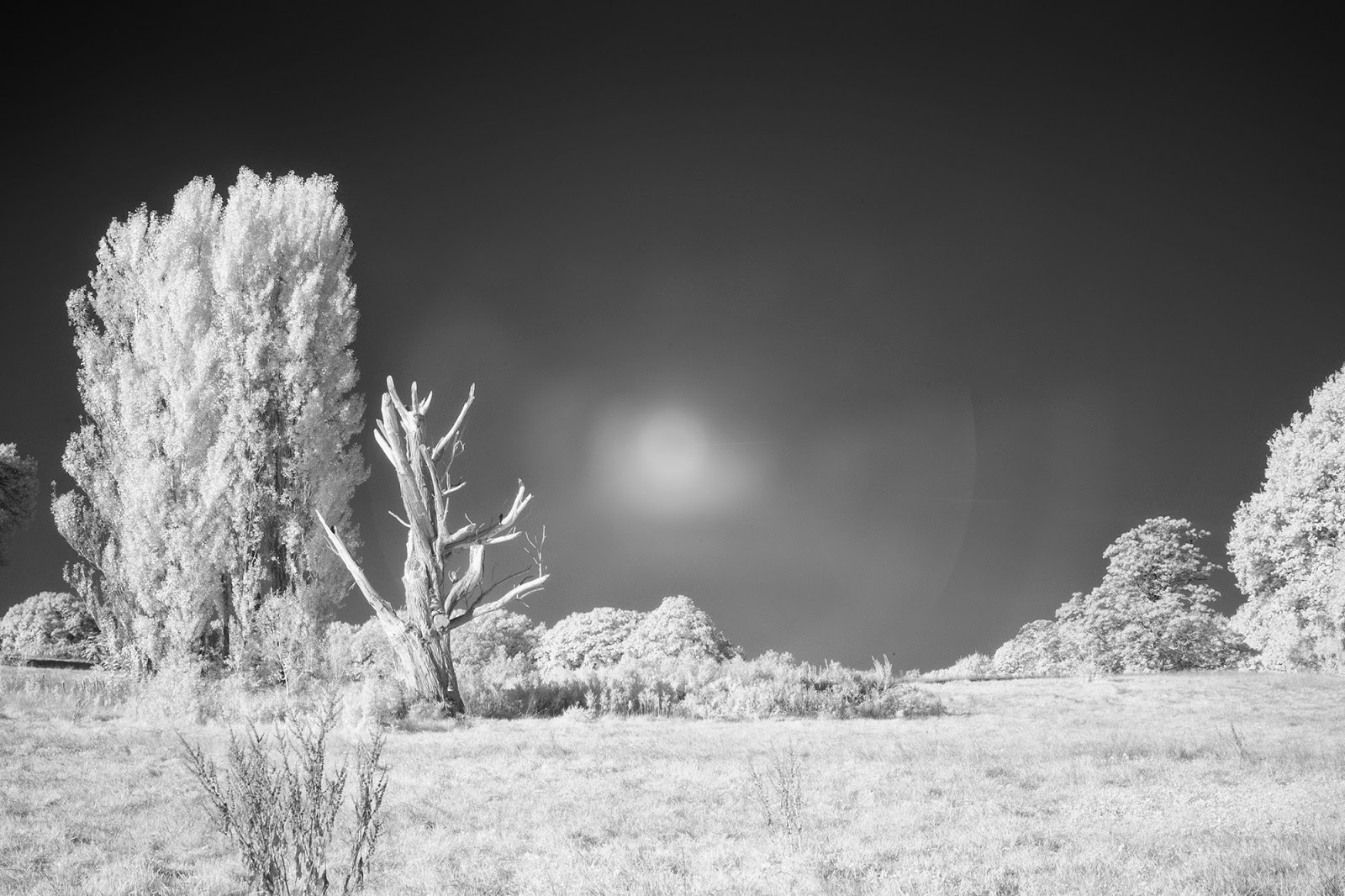
The culprit is the lens itself and unfortunately it cannot be fixed. It's caused by bright parts of the exposure reflecting off the coating inside the lens (and/or the elements) and back to the sensor. These coating are designed to absorb light and stop it from reflecting, but how well this works for infra-red light is quite random.
It's worth noting that even when a lens is highly susceptible to this internal reflection it may only be obvious in 10% of your images or less. It's not only dependent on scene contrast & angle of light, but it shows up more clearly on dark flat tones and is deminished by wider apertures.
The Consensus & The Problem
There are a few websites that talk about hot spots and what lenses it affects. Both Life Pixel & Kolari Vision have a list (the latter being the most extensive). These, and many other websites that mention the hot spot issue, generally categorize lenses as simply either good or bad. However, due to subjectivity and various reporters, I don't feel that this black and white evaluation is the best approach.
After shooting primarily infra-red on a mirrorless camera for more than a year, with various types of lenses (old and new) I'd like to re-evaluate how IR hot spots are reviewed. I see this issue as something that affects every lens to varying degrees (like sharpness or CA). I've used several lenses described by several sources as not suffering from hot spots and still found the issue (although they do usually suffer from it less than others) and not just when stress testing.
My aim is to make a new review-category for each lens that I use. Something that will better show infra-red photographers how well each lens copes with the hot spot issue and better aid them in future acquisitions.
The Plan
The above example (from the Mitakon 50mm f/0.95 @ max aperture of f/16) is the worst I've seen from this lens, it's also one of the worst hot spot I've ever seen. There are a few reasons why this scene shows the issue so clearly and this gave me an idea. I plan to use a similar set up to measure the IR performance for each lens that I test. Let me first explain the technical details of this test...
For this test I will use an 850nm infra-red filter (B+W 093 or Kolari K850), which lets through mostly IR light and this produces better contrast than say the common Hoya R72. This helps show up the hot spot issue more clearly. Since hot spots are essentially a white blob in the middle of the frame it helps to locate them with a clean dark centre to the image. I achieve this using a clear blue sky and face away from the sun (as directly as possible). To best contrast this I fill as much of the outer frame with well lit foliage and due to facing away from the sun this should be as bright as possible.
Camera Settings - Firstly, I set the camera to auto exposure, with +1 stop compensation. Aperture is set manually. Shutter speed and iso are left to the camera as I go through the entire aperture range. For each shot the focus & exposure is set on the foliage, before moving some clear sky into middle of the frame to release the shutter. Once back on the computer I process all the images in RAW. Other than the saturation being set to 0, the only other adjustment is done in the curves to maximize the histogram and balance out any small differences in exposure.
Problem - The first complication here is that all lenses suffer from vignetting when at their widest apertures. This confuses the results a bit because a dark vignetted border looks rather like a large hot spot. I don't believe that these two issues are intrinsically linked, rather that when a lens is wide open, infra-red images are showing both vignette and a hot spot at the same time. The hot spot is just so big that the effects are amplifying each other and are difficult to separately identify. If you look at the effect (below) at f/22 and work your way back up the images (as the aperture opens), what you see is an effect that essentially blurs out. It gets bigger and less intense, but it never fully goes away. The more infrared images I analyse from different lenses the more I feel that this might be a rule.
The Results - I recently purchased two of Sony's auto focus primes for the A7. Here's how they performed in IR, using this new hot spot test scene:
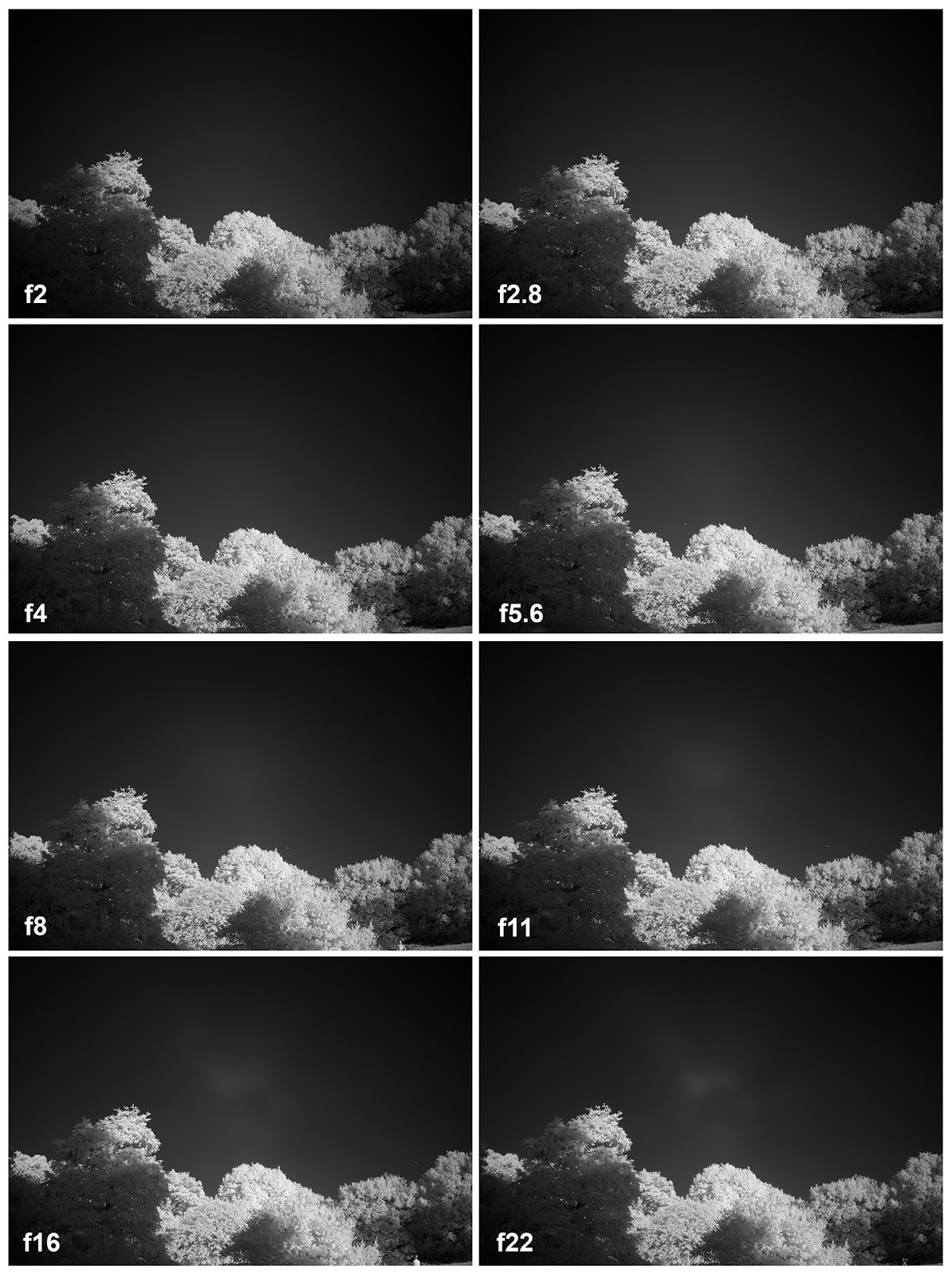
This Sony 28mm lens is not the best or worst for IR, but I can still see the effect at f/2. It might be subjectively acceptable here somewhere in the middle, but if this issue really bothers you it might only seem reasonable at f/2.8, which could make it a terrible lens for you. This is where all the subjective assessments get tricky to read with Kolari's list. It's worth noting here that this is the worst case scenario. In general shooting it's mostly fine at f/11 and I've even shot images at f/22 where I've seen no hint of hot spot. It all depends on what's in the middle of the frame, what angle you shoot into the bright areas and its relative intensity to the rest of the scene.
So you've seen one bad example and one slightly annoying one, but now for an example of a good infra-red lens...
Zeiss 55mm f/1.8
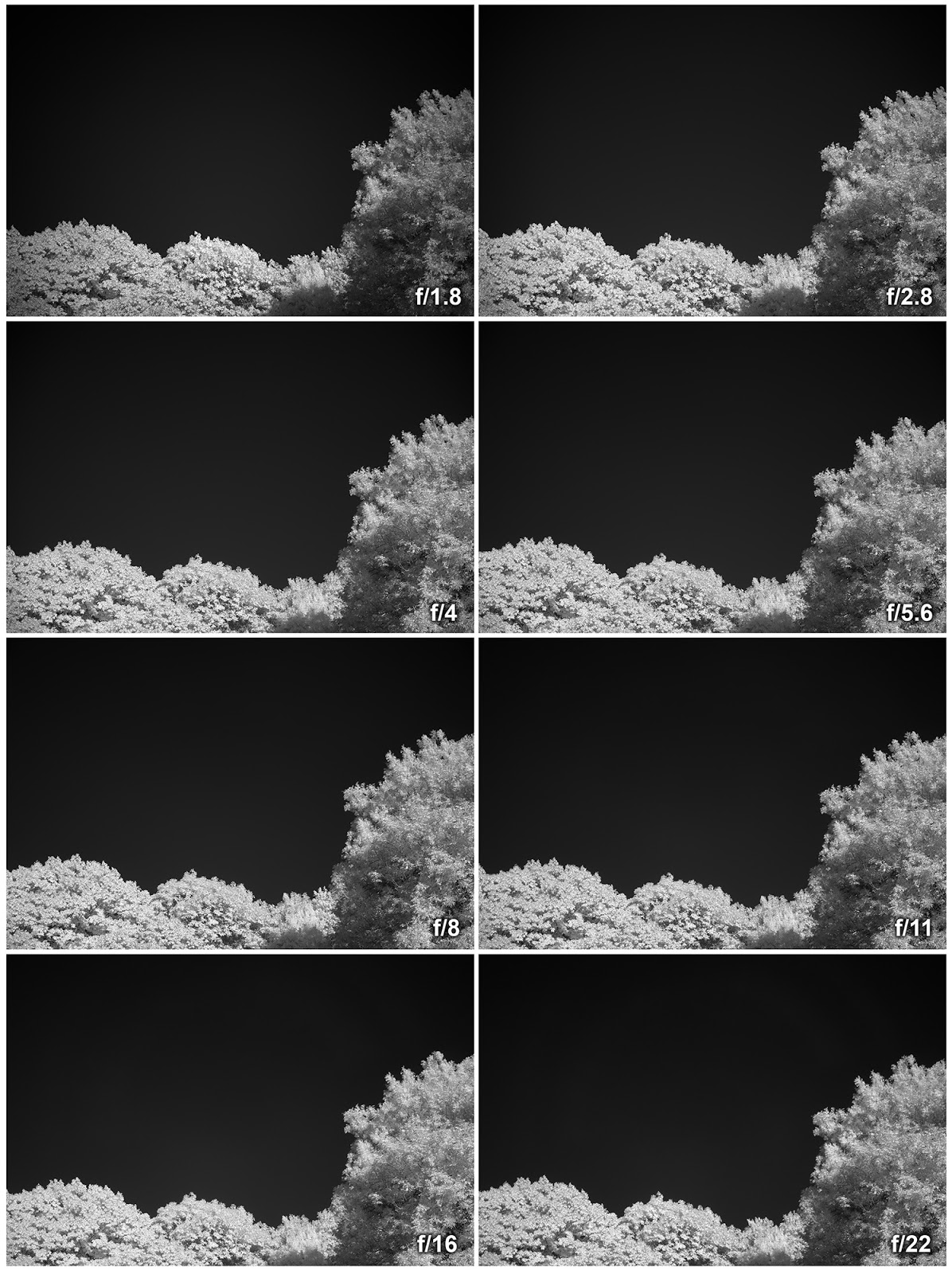
I recently bought the Carl Zeiss Sonnar 55mm f/1.8 lens for the Sony A7, but before I did I had no idea how it would perform in IR. In most circles this lens is considered to be extremely good for visible light photography, and I'd have to agree (DxO give it the highest score of any autofocus lens). In infra-red there's just no guarantee it will work well. I was well and truly crossing my fingers when I first took this lens out with the IR filter. The Zeiss 35mm f/2.8 was the only other prime lens around when the Sony A7 was launched. I borrowed that from a friend a few months back and found out that it produced quite an obvious hot spot from about f/5.6, so this made me nervous. Fortunately though, this Zeiss turned out to be not only the best performing Sony AF lens so far, but it's the best lens I've ever tested, period!
That said, although this is the cleanest looking infra-red samples I've seen, @f/22 it's not quite 100% void of issue. If you look closely you'll see that there is a large, but faint disc starting to appear at the top of the image (monitors with high gama show this more clearly). This is a mirror image of the bright foliage at the bottom, but in an even more odd pattern than the 28mm and extremely subtle. So, as close as this Zeiss lens gets to perfection, thus far I've not found a lens that produces zero hot spot effect at all. Right now I'm wondering whether any exists when subjected to this kind of intense test.
Here is the last image from the Zeiss 55mm @f/22, brightened up by several stops, to show the effect:

Don't let this pushed result fool you though, this lens' IR performance is right up there with the best of them. Well that's my current experience anyway, but I haven't tested every lens, so...
Feedback
If you have a lens that you think performs better than the 55mm Zeiss here please let me know which they are, or better yet try to replicate this test and share the results. I appreciate any feedback you may have on my thoughts here, Especially if I have gotten anything badly wrong.
Reviews
These two images go a long way to forming the basis of the next two reviews that I want to write (Sony 28mm / Zeiss 55mm). I will be rewriting the existing reviews in new format before I tackle those, but they will be coming soon.
Weather
Due to the rather 'changeable' weather here it may take me some time to test all my current lenses. Clear skies are not all that common, but I will do my best to update all the old reviews and will continue to work on new ones as well.
