Showing posts with label Photos. Show all posts

Sunday, 1 June 2014

Lens Review - Nikkor 35mm f/2.0 AF-D


I'm making these lens reviews to illustrate their capability at capturing infra-red images. The Sony A7 platform is great for displaying almost any 35mm lens' full potential on digital (via adapters), so I'm now capable of testing nearly any lens I can get my hands on. These review won't be exhaustive or hugely technical, they'll concentrate on real world samples and experiences. Mostly it will help point out the ones to avoid when choosing a lens to shoot in infra-red.

I hope to build a good library of reviews by borrowing lots of new and old lenses from friends, but I have a few to start me off and also have my eye on a few to buy, so hopefully this section will grow quite quickly.

Note: Corner quality is difficult to quantify with infra-red for a host of reasons, but I will do my best to review around these issues.

    IR Issues
I open with this topic because it's the most important factor when choosing which lens not to use for infra-red photography. I can happily confirm that this lens does not suffer from the infamous hot-spot issue. I have tested it at various apertures (which would effect the size/intensity of hot-spots if they show up) and I've seen no hint of it here. Flaring can occur more in IR, but although it'll be a little more intense I don't think it'll bother anyone at these levels. You get crazy lens flares if you get direct sunlight on the front element, but that's true with any lens and equally true of colour photography. The contrast and clarity of this lens are equally as good with infra-red as with visible colour.

    Filters
The 52mm filter thread is great for infra-red shooting. Filters for this size are common and reasonably priced. Since so many prime lenses share this thread size (most 24-50mm prime lenses for example) you won't mind getting filters in this size because of their versatility. Adapting down to 49mm thread size (a common older size) is also pretty painless, the step-up adapters don't add enough bulk to make it awkwardly sized. The Filter thread here is plastic, so it can be a little fiddly, but it doesn't rotate when focusing.

    Handling / Physicality
This lens is really quite small and light lens considering it's maximum aperture and minimum focus distance. If used on an SLR (I've tried it on Canon and Nikon) then it's very small, but adapted to short flange mirrorless it gains a bit of weight and nearly doubles in length. It doesn't make it horrible to hold or use, but it's a shame considering what it can be and looks a little front heavy (which it isn't really).


    Aperture
Most lenses this size and weight have a maximum aperture of f/2.8 so it's nice to have an extra stop here. It's especially appreciated as a general or travel lens because it makes it better for low-light use. The older manual focus metal Nikkor AI-S 35mm may have a maximum aperture of f/1.4, but it's bigger, much heavier and more troublesome with it's image quality.

Being an older AF model this lens has a physical aperture ring, which means it works well when adapted to work on other platforms, like the A7. I must say that it's a rather nasty plastic mechanism though and I really quite dislike Nikon's lock button (it locks the aperture to f/22) - for automatic aperture setting. This lock stops most new Nikon bodies from simply erroring, when set to any value other than f/22. It's a horrible functionality, which I really wish didn't exist. It's especially annoying if switching from a Nikon camera to a non-Nikon camera often.


    Focusing
Autofocus speed with this lens is good, but not having an internal motor it's rather noisy and won't work on cheaper Nikon bodies (which only support AF-S lenses). When adapted to mirrorless camera bodies my main gripe with this lenses focusing is that the focus ring is very exposed on the front corner. Since it has almost no friction it's very easily knocked, so even when using a reliable hyper-focal distance for landscapes you'll need to constantly check the focusing. Being an AF lens it's not the nicest focus mechanism, but it's not too annoying to use either.

The minimum focus distance of 25cm (remember that's from the back of the lens!) is very close for such a small lens with a decently wide maximum aperture. You won't quite get to macro levels, but it's great for subject isolation at f/2.

Happily this lens has both the hyper-focus distance and infra-red offset markings on the top. Like aperture rings, these are generally very useful despite being lacking on most modern lenses.


    Sharpness
I would classify this lens's optical clarity as good in the middle and average to below average on the outer edges (on full-frame), but considering it's a fairly reasonably priced older prime I was pleasantly surprised by it. Although it's lacklustre edge performance gets worse at the widest apertures I think this is where this lens shines. "What the hell is he talking about" I hear people shout, but hear me out... It doesn't lose too much sharpness, or get too hazy wide open, so when focusing close (say on portraits) its relative sharpness is really quite impressive overall.

With some stunningly good lenses coming out recently (at least on paper), pixel peepers will probably not be happy with lenses from this era, but I really quite like them and this one especially. If that puts me in the character loving column then so be it. To me it's the image as a whole that's important beyond all else and you shouldn't have to zoom into an image to see how good it is. Some people will argue that the photo could be blown up to the size of a building, but I always see images being viewed the same way, no matter the size or pixels count. Whether you agree with me or not is not hugely important, but I hope this helps illustrate my thought process and allows you to gauge your own conclusions from this.

    Bokeh
Being a wide aperture prime lens addict I'm leaving my favourite topic until last, although so far I've struggled to apply it quite so well to infra-red as I have with colour.

The bokeh quality of this lens doesn't elevate much beyond average, but it does have one trick up its sleeve. It has good potential with the amount of bokeh, due to its close minimum focus distance. This makes up for a lot of that lacklustre quality. When shooting at or near to this distance it's possible to thrown the background out really well, more so than most 35mm f/1.4 lenses. To my mind this helps give a better relative impression of sharpness. Combined with good subject isolation (3D pop) this is why I appreciate bokeh and why my view of this lens is elevated by it's close focus abilities.

    IR Samples

▲▲  Heliopan #25 (red) @ f/8  ▲▲

▲▲  B+W 093 (850nm IR) @ f/2  ▲▲

▲▲  Heliopan #25 (red) @ f/11  ▲▲

 ▲▲  Heliopan #25 (red) @ f/5.6  ▲▲


▲▲  Heliopan #25 (red) @ f/4  ▲▲


▲▲  B+W 093 (850nm IR) @ f/8  ▲▲


▲▲  B+W #22 (Orange) @ f/2  ▲▲


▲▲  Schott RG665 @ f/8 ▲▲

    Conclusion
This is a very nice little lens for it's price, especially if you can find a second hand one in nice condition. It's a lens that I keep coming back to for infra-red because of it's versatility of use. It's larger and a little heavier on mirrorless cameras, but it's still a compelling option for various subjects. I like this focal length for taking almost anything, the f/2 aperture is great for such a small lens and the shallow depth-of-field is really quite impressive when focusing close. If you can take advantage of the autofocus I'd say it's a no-brainer, but if you're buying second hand be careful of oil leaking and making the aperture blades stick (an issue that plagues earlier versions of this lens).

    Scores
IR Clarity (lack of issues): 10/10
Sharpness (Middle): 7.5/10
Sharpness (Edges - FF): 4/10
Sharpness (@ f/2.0): 7/10
Bokeh quality: 4/10
Bokeh amount: 8/10
Size & weight: 9.5/10
Lens Markings: 9/10
Versatility: 9/10
Value (used): 7/10
Value (new): 8/10

Overall Score (Colour): 8/10
Overall Score (Infra-red): 8/10
Highly Recommended
Saturday, 5 April 2014

Photos - Richmond to Kew - Fuji X100


The following photos were taken on a walk from Richmond train station to and around Kew Gardens. My equipment list for the day was: A tripod, the Fuji X100 and a Hoya R72 filter. This is a nice walk to do in good weather at a photographer's pace. Depending on how far around Kew Gardens you walk at the end this is going to be about 4-6 miles. You can go back on the train from Kew, saving you from retracing the walk along the Thames and getting a bit bored and/or tired. 

     General Info
  • All of the following photos are taken using a stock Fuji X100. The filter used was a 49mm Hoya R72 (720nm), which requires an adapter.
  • This camera and filter were used hand-held for some of the following shots. This requires ISO values of 1600 or above using the lens wide open (f/2.0). You can then get away with 1/4th - 1/40th of a second exposures. Today however I wanted some sharper and more grain free images, so I used a tripod. There was a lot of wispy clouds here but the sun was consistently strong and it gave exposures between 3-10 seconds @ f/5.6 using ISO 200.
  • The processing I used here includes the 'False Colour' technique. This involves swapping the red and blue channels around using the channel mixer in Photoshop. 

This first photos was our first view of the Thames after walking through Richmond town centre. This shot was quite lucky as the paddle steamer left just after I took this. At this point we started walking north along the Thames (to the right of this image). This took us around a park, a golf course and eventually Kew Gardens itself, but the entrance to the gardens was still about a mile (1.5km) beyond that.

The large amount of clouds here weaken the typical dark skies of a dynamic IR photo. Despite this the water retains its usual dark tones. This suggests that these tones come from the water itself rather than anything it might normally be reflecting - like the sky. 


The haziness around the top of the fence is cyclists moving past while the image was exposing. In hindsight I should have waited until there was nobody there.


  • Contrast detail in bricks is often greater than the same colour image. 
  • Shadow detail is more prominant in IR while contrast remains high.
  • The red colouring of foliage originally comes from the blue channel of the original infrared image. This is transferred to the red channel in post process.


The motion from people and wind swept trees is difficult to eliminate when using low ISO and moderate apertures on a non-converted (normal) digital camera. With the camera's (standard internal) filter blocking most of the IR light there is little light left when using an external IR-pass filter like the Hoya R72 and worse still using anything higher than 720nm. 


  • Converted infrared cameras can fix this issue, but it costs at least £200 and usually means the camera can no longer take colour images. 


On top of the 'Richmond lock and Footbridge', just after a boat had passed through.


  • The motion of the boat moving off (top left) and the closing lock gates are perhaps a little less desirable. This sometimes makes me wish for a converted IR camera, but when I can be bothered to lug a tripod around I do like most of the motion effects.


A photo of the 'Richmond lock and Footbridge' itself. It didn't seem to stop east Richmond flooding later that day. We saw people stood on pub benches around 5pm (during the train ride home). 


Since we were here in low tide and there were some steps, the wife and I decided to explore the water's edge.

  • This was shot at 1/25th of a second @ f/2, ISO 1600. This camera and filter are very acceptable to shoot with in strong sunlight due to some very good quality high ISO noise performance and a relatively low light lens. Not every camera works as well as this so if you are interested in shooting IR without a tripod check to see if anyone else online has tried it first.
  • For more information on the hand-held abilities of the Fuji X100 check out my previous post here.


A spill-over from the stagnant river on the other side of the Thames path (right). I love the uneven cobbles (left), which I assume is a result of tree roots.

This illustrates the nice effects that you can get with a tripod and some slower shutter speeds when dealing with moving water. A waterfall would have been nice, but there aren't too many in London. 


Finally in Kew Gardens, where we sat to have a rest under a tree :).


This image was an exercise in manual focus, timers and guesswork. This explains why we're so off-center here, but I kind of like the way it came out. Here are some ways that the tones of people come out differently in infra-red compared to colour:


  • Skin tones come out very pale in infrared. They also don't show many blemishes at all (the opposite of ultraviolet, which is very unflattering), which gives an almost 'china-doll' like effect. 
  • The glasses are tinted and thus dark in visible light. Here they look more like safety goggles because infra-red light passes straight through this material. 
  • The eye colour (around the pupils) seems the same tone in both of us here. In reality my wife's eyes are very dark brown and mine are very pale blue.  

Some bluebells, showing up red because of the 'False Colour' channels swap technique.


Plants a water are usually enough to interest me in an infrared shot, but this one got me most with the intensity of the reflections in the windows of all those lovely trees.


Plants growing over or through dark objects is often a great subject for IR and I am happy with the way it came out, just wish I had waited for the people to have gotten out of the middle of the shot.


I do love the effects IR has on water, not only the tonal, transparent and reflective differences but also mixed in with the motion from the slightly long exposure. 


One of my last shots from the day. I couldn't resist the twisted texture of this tree in stark contrast to the completely straight lines of the one behind it.


  • This was also a long exposure (around 6 seconds). There were quite a few people in frame, but only this guy came out because he stood still for such a long time.
  • There is a hot-spot starting to form here, so yes the Fuji X100's lens does suffer from this, but only stopped down a bit on longer exposures some of the time. This won't be an issue while using the camera hand-held because of the wide aperture.

Friday, 21 March 2014

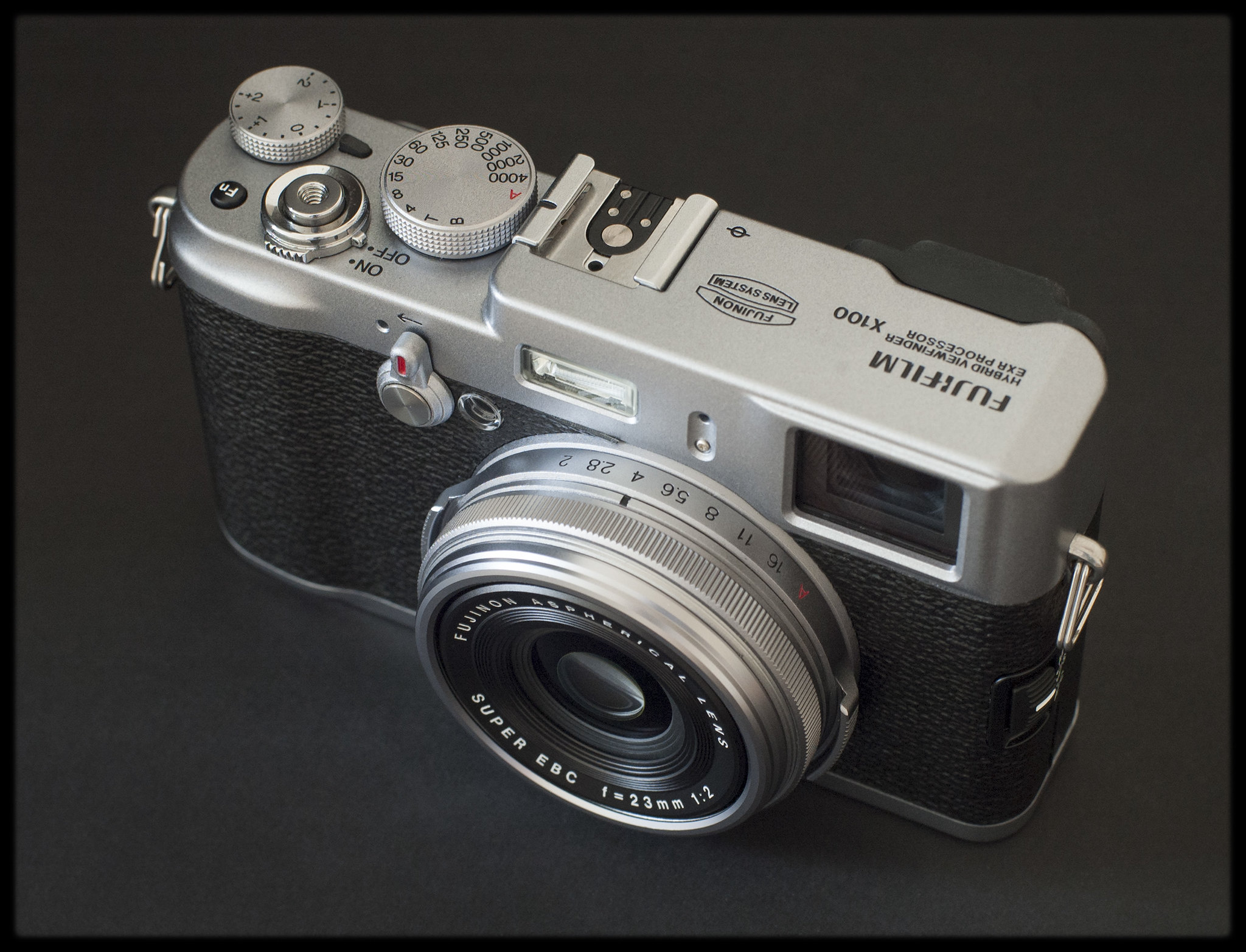
Cameras - Fuji X100 & The Hoya R72 Filter

Kew Gardens, SW London - Fuji X100, 23mm - 20 sec, f/8, iso 200

It's time for the next chapter in my infra-red camera history...

A couple of years after selling my infra-red converted Canon 40D (2008) I noticed a sharp drop off in picture taking as a whole. The main reason for this was that my remaining DSLR was a pro model and thus too big and heavy to carry around everywhere. Something needed to be done to rekindle my passion for photography, so I started to look for something more compact. I wanted to keep the really high image quality and good manual controls, just lose all the bulk.

I'd followed the Fuji X100 from its announcement. I loved the looks and features, but initially dismissed it because of a relatively high price and a couple of feature niggles. A year on and the price dropped drastically however. It was then available for around half the original asking price on Fuji's refurbished website. I couldn't ignore it any more, so I finally bought one and boy was I not disappointed.

Nikon D70s, 50mm - 5 sec, f/8, iso400

   Controls - The Way They Were Meant To Be
It might look like a hipster's wet dream (well from the front anyway), but the retro dials are even more amazing to use than they are to look at. Apart from some fiddly iso controls (an auto iso toggle button would have been perfect) it's an extremely easy camera to use. The image quality produced by the sensor is superb for such a small camera. The clever optical and electronic viewfinder are large and very well implemented, but more on that in a minute. The effective 35mm prime lens is incredibly small, great in low light and has very decent image quality. I already love prime lenses, but if you're not concerned about the possible inflexibility I strongly advise you reconsider. 35mm is good for most 'normal' photography and a pretty great angle to be stuck with while travelling, just check out some samples from the X100.

   Killer Feature
Well, I could go on about Fuji and the X100 for ages, but "what has this got to do with infra-red?" I hear you ask. Well, unlike most modern cameras, the X100's internal UV/IR cut filter is not particularly aggressive - about 11 stops. OK, so that's not exactly subtle either, but some of the X100's other features step up to make it a viable hand-held infra-red camera. The wide aperture lens and great high iso performance from the APS-C sensor push the exposures back into an acceptable range. The first image that I posted above was taken on a tripod, which is all well and good, but let's prove the hand-held shooting ability of the X100...

Highgate Cemetary, London - Fuji X100, 23mm - 1/15th, f/2, iso3200

This infra-red photo was taken under the canopy of trees. This was a hand-held shot of a moving subject. It's not the best example of an infra-red image, since none of the cat's tones look any different to colour, but it does help illustrate the camera's potential. This image is a little noisy, but considering the camera is fairly new, not converted and the conditions for the photo are mildly tricky this is pretty impressive. 

All this adds up to a camera that can shoot infra-red images without the need of a costly and damaging conversion. Not that it's possible, I actually tried once. On that note I think it would be a fantastic idea to have the camera as 'full-spectrum', using the internal ND filter as the UV/IR cut filter and then external filters could be used for really high quality, fast infra-red photography. This would barely affect the camera's normal colour abilities and could and would make for one heck of an IR camera!

London - Fuji X100, 23mm - 1/30th, f/2, iso1600

   What To Buy & How Much
The official 49mm Hoya R72 filter is normally priced around £50, but you can save quite a bit by shopping around, buying second hand, or getting a generic one. To attach the 49mm filter to the X100 you will also need the lens hood adapter. The official one of those is about £70, but again there are third-party ones costing much less. I think I spent £22 on my IR set up for the X100, so if you own this camera and you haven't tried out infra-red photography yet what are you waiting for?!

Kew Gardens, SW London - Fuji X100, 23mm - 1/15th, f/2, iso2000

   Viewfinders (Optical and Electronic)
The X100's mix of display types compliment it's IR abilities nicely. The option of having both optical and electronic viewfinders normally useful, but for shooting infra-red it's a huge advantage. Because the optical viewfinder (OVF) doesn't look through the lens (like an SLR), it can still be used while shooting in infra-red. The added bonus is that the electronic viewfinder (EVF) works reasonably well when shooting in IR too. Since the camera is having to boost exposure for IR the frame-rate of the EVF does suffer, but it still works well enough. Actually shooting with the EVF is advised for focusing reasons and this is not restricted to infra-red shooting. Sometimes the X100 misses focus, but acts like it's locked, so when looking through the OVF there is no feedback to tell you something's wrong.

   Game Changer
The real benefit to the EVF here is that it shows you a real-time view of the world in infra-red. This is brilliant for a number of reasons. Unlike an SLR you don't have to guess what your tones and colours look like. It makes composing a scene much easier and it looks great.

OK so an EVF is the same view you get on the back screen, or live-view on a DSLR. The problem with those is that they can't easily be seen in bright sunlight and it's these conditions that you'll need to be shooting in to get hand-held infra-red photos from a non-converted camera.

Fuji X100, 23mm - 1/15th, f/2, iso1250

   Significant Limitations?
The X100 is very usable for hand-held infra-red shooting in great weather, but take away the perfect sun and it gets depressing quickly. Dark scenes will almost certainly cause the camera's focusing to fail, but is this all bad? I mean infra-red tends to only look great in bright sunshine anyway. I wouldn't recommend shooting infra-red indoors mostly because those images are boring anyway. High levels of noise or slow shutter speeds (take your pick) will just guarantee your images will suck, but they were going to anyway so who cares.

When trying to limit the noise levels of your hand-held IR images, on the X100 you'll be stuck using the widest apertures available. I suggest locking the aperture at F/2, but what about the IR focus issues? Fear not, here is another feather in the X100's infra-red cap. Although it uses the slower contrast detect AF (unlike the X100S), this guarantees accurate AF in whichever wavelength you shoot and this makes wide apertures a non issue.

So there you have it. Not the worst limitations in the world, especially when you consider that the X100 was never built to be an infra-red camera.

Richmond, London - Fuji X100, 23mm - 10 sec, f/8, iso200

   Tripod shooting
Exposure wise you won't have much room to move when shooting hand-held, but you can of course still use a tripod if you so desire. This makes interior, low-light or base iso infra-red shots at least possible.

At base iso and stopped down to decent apertures, the X100's exposures may be too long for hand-held shooting, but for cool effects (like moving water) they're just long enough without becoming too annoying.

The main benefit to base iso is low noise levels and this makes colours infinitely more pliable when pushing their channels around. The above image was processed using the false-colour technique (red/blue channel swap). It was then pushed further still to achieve this orange/pinky cast. A hand-held shot at high iso will become undesirably grainy if processed the same way. To that end I also recommend shooting RAW when taking infra-red shots, even if you normally don't.

Hampstead Heath, London - Fuji X100, 23mm - 1/15th, f/2, iso1250

Here are some comparisons between different filters used on the X100. The top left image was taken without a filter and simply turned black and white in the RAW editor by reducing saturation. All shots were taken on a tripod so they could all be base iso. Here are some of my observations:

   650nm (Cheap, Generic)
This filter really did nothing. I'm not sure weather it was a dodgy filter (I don't think so), or that the camera would need to be converted to get the most out of this wavelength. I've seen some interesting effects from cameras using this wavelength, but i think they all had their internal UV'IR filters removed.

   720nm (Hoya R72)
This is the common Hoya R72 filter. It's great for colour and black & white shots and is what I use 99% of time on the X100. There's not much to say here accept that it works well. This is the wavelength I would recommend for anyone trying infra-red photography. It's possibly the only one you will ever need.

   760nm (Cheap, Generic)
This eliminates any colour effect from the infra-red image. Not that we're showing colour here anyway, this is all about tone. In theory the higher cut off point of the wavelength can produce more contrast, but this is so minimal that it's something you can push equally in post process. It doesn't negatively effect exposures much, but it just doesn't provide much of a difference either. The difference you see in the water are due to a duck swimming past in one shot, but not the other. The only thing that makes me thing there's a difference is the brighter tree in the middle of the photo. Still, I wouldn't bother with this filter unless you just see no point in colour IR. If you feel the need for greater contrast then I'd suggest going higher still. The 830nm (ish) B+W 093 filter will almost certainly still provide something, but much higher than that could provide nothing at all on a non-converted camera like this.

Highgate Cemetery, London - Fuji X100, 23mm - 1/15th, f/2, iso1600 (Sam Grice)

This image was taken by a friend who bought the Fuji X100 at a similar time. He used a third party filter here. It was rated at 720nm, but seems to let give slightly faster exposures so perhaps it cuts off  little lower down the spectrum (perhaps 700nm). These rather fetching colours come more from Sam's processing than the filter's character. It shows how much can be done with processing. I will go over some different image manipulation workflows in later posts.

Hampstead Heath, London - Fuji X100, 23mm - 1/30th, f/2, iso1600

Having a camera that can shoot colour and IR is great in harsh / bright conditions. When normal colour images tend to get killed by overly contrasty tones IR can keep things much more grounded. Although the highlights still blow out and flaring can be a real issue there is simply something very pleasing about the dynamic range of a sunny infra-red photo. The flexibility of the X100 helps to keep me motivated through periods where my passion would otherwise fall.

Kew Gardens, SW London - Fuji X100, 23mm - 1/15th, f/2, iso800

   Conclusion
I absolutely love the Fuji X100. The manual dials make it the nicest camera I've used so far. As an infra-red camera it is truly amazing and this is out of the box. Not needing converting means that it provides a nice jumping off point for existing X100 owners to play with infra-red for very little money. That's a rare and amazing thing. This camera has made me realise the power of the EVF, which can be used for colour and IR equally well.

I'm not sure exactly how good the X100s is for infra-red, but the internal filter seems to block about the same amount of IR light from looking on Flickr images. Although the phase detect auto-focus could cause issues with infra-red it seems to do OK. One thing is for sure and that's the improved high iso performance is nice. 

Saturday, 15 March 2014

Cameras - Canon 40D (Converted to infra-red only - 700nm)

Nine Springs, Yeovil - Canon 40D (IR), Pentax 50mm - 1/500th, f/1.2, iso100

I was getting on so well with infra-red photography on the Canon G9 that I was starting to crave a more serious camera. At this point the idea of combining IR with a fast shutter response, a large optical viewfinder and the higher image quality of a digital SLR was just too tempting. I did some research and decided to sell the G9 to fund the purchase of a Canon 40D and conversion. This would be the next step in my infra-red project.

Shortly before this I managed to swap some old equipment for a Canon 5D. This was my first experience with a full-frame DSLR and using a 50mm f/1.2 lens was making me quite addicted to bokeh (shallow depth of field blur). This was partly responsible for pushing me away from Nikon and towards Canon for conversion to IR as I was more tempted to put money into Canon glass at this point.

Unlike the G9 I didn't buy the 40D already converted, although I did choose it with conversion in mind from the start. I took some 'normal' colour images with it for a couple of weeks before sending it to Germany for conversion, in mid 2008.

The Pentax MX film camera next to the cropped sensor Canon 40D with Pentax adapter

Another aspect that pushed me towards Canon when choosing an SLR to convert to infra-red was the lens options. Despite being a bit of a Nikon fan-boy at this time I moved to Canon for a couple of reasons. The first was that Canon have wider aperture prime lenses available (albeit at a cost), but perhaps an even better reason was that the Canon mount can take lenses from almost any other manufacturer. This is made possible by simple, small and very cheap adapters that don't require any optics to degrade image quality.

The first image in this post was taken using a Pentax 50mm f/1.2 lens on the Canon 40D. This is shown in the above photo next to an old Pentax film camera for scale. Although you're stuck with manual focus on third-party lenses, this is actually quite useful for infra-red photography anyway. As an extra bonus there are some good bargains to be had with older manual focus lenses and this is equally true of low-light prime lenses (like these).

Canon 5D, 50mm - 1/60th, f/4.5, iso100

Perhaps my second biggest reason for choosing the Canon 40D for IR conversion was a new feature it had: Live-view (LV). I like high contrast black & white filters, but I also like colour infra-red (like the Hoya R72). I didn't want to be stuck shooting only one filter type after conversion and live-view made this possible. It would allow me to shoot fast shutter speeds using IR filters in front of the lens, but I could also shoot with the optical filter on the lowest wavelength I chose for conversion. The plan was to convert the camera to the lowest wavelength of IR that I liked to shoot (700nm). I could then add a more aggressive filter to the lens and use live-view to continue shooting (see above). This worked brilliantly mostly because of how intuitive the 40D's live view was.

I have tried live-view on several Nikon cameras (D3, D600) since and I'm not sure I would recommend them as much as I would a Canon for this single feature. Nikon's LV experience was less usable and rather frustrating for general use thus far. This was the first thing to put me off converting one of the Nikon cameras (listed above) to infra-red as a new project.

Cameras (especially DSLRs) have gotten smaller, lighter and cheaper since the 40D, but now that electronic viewfinders (EVF) are getting so good I'm not sure I can keep recommending DSLRs over mirrorless cameras for infra-red conversion. If you like the idea of shooting various IR filters on a converted digital camera I would recommend one of these EVF cameras (higher is better):

  • Sony A7
  • Fuji X-T1
  • Fuji X-E1/2
  • Sony NEX 6/7
  • Olympus OM-D
  • Panasonic GX7

Essentially this is my personal preference of interchangeable lens cameras (ILC) that have an EVF. This order is based on sensor size, handling and lens potential. I hope to talk more about these in future posts. I could rant the list and its order for ages, but for now I will get back to the converted 40D.

The 40D made a fantastic infra-red camera for it's day. I really enjoyed shooting with it as an SLR and the live-view was not just a gimmick, it made the camera infinitely better at shooting IR. Here are some pictures while I continue to babble about my experiences shooting with the 40D (post-conversion):

Central Amsterdam - Canon 40D, 24-120mm - 1/50th, f/8, iso100

This shot has had very little processing done to it, especially in the colours. The white balance's colour temperature slider is lower than it would be with a colour image, but it's not at the bottom (2000), where I'd normally put it. Very rarely do I find the default colours from an infra-red image to be pleasing. If I do keep the colours about 90% of the time I will use the false-colour technique to process the image.

Paradise Wood, Dorset - Canon 40D, 10-22mm - 1/200th, f/8, iso100

With it's much larger sensor the 40D's improved sharpness and dynamic range really helped false colour to remain relatively free of banding and noise. Compared to the compact G9 this was a huge step up in visual quality. Although the 40D was a much heavier camera it enable me to capture moments more reliably and made for a more pleasant shooting experience overall.

Montacute - Canon 40D, 10-22mm - 1/80th, f/5.6, iso100

At some point while shooting with the converted DSLR it occurred to me that I mostly took landscape images and this might better suit a wide angle lens. I chose the Canon 10-22mm. Being relatively cheap, light and not too big it was good for a walk-around lens. Sharpness and maximum aperture were poor, but it did an OK job overall. The main thing that made me regret buying this lens was that I used it fully zoomed in almost all the time. 22mm (on the 1.6x cropped 40D) was very close to 35mm lens on full-frame. 35mm prime lenses are often available with nice wide apertures and are still very small and light. This makes great for general use and available-light photography and this realization was ultimately what drove me to buy the Fuji X100 later on (more on that soon).

Lens options in general were simply stunning on the Canon mount. Canon's own lens options are great already, add to that 3rd party options (from Sigma and Tamron etc.) things get very interesting, but the real benefit to me was the ability to use manual focus lenses from almost any manufacturer's own catalogue (Nikon, Olympus, Pentax, Minolta, Zeiss, Leica etc.). The only down side for the 40D was its cropped sensor, which made wider lenses focal lengths not so ideal.

Canon 40D, 50mm - 1/5000th, f/1.2, iso100

The ability to change lenses with infra-red really amp'd up my passion for the project again. First stuck on a tripod and then limited to a mediocre lens on a tiny sensor, but no longer. If I wasn't completely hooked infra-red photography before I was now.

This image of my parent's cat (Marmite) shows how bad his camouflage is when surrounded by infra-red bushes. If only birds could see in IR huh? Well don't worry, he's a rubbish hunter anyway.

Focusing on his eye with the very shallow depth of field was only possible due to manually focusing using live-view. Since infra-red light focuses at a different distance to colour (and every lens is different) live-view really helped capture images more successfully (zooming into 1:1 pixels at the push of a button). This was a great feature for infra-red and so good was the functionality of live-view on the 40D that I often used it when there was no filter attached to the lens. A feature that I chose to act as a backup for when the optical viewfinder was unusable was now becoming a preferred way of using the camera.

Canon 40D, 50mm - 1/6th, f/1.2, iso100

After observing the effects that infra-red photography had on people's skin I was extra curious to try out studio photography. In hind sight I wish I had tried a lot more than I did, but I am glad that I got the chance to try a few. These images were all thanks to Rob Hargreves of Nimbus Photographic, for letting me join in on some of his photo shoots.

The way infra-red smooths out skin tones makes for a flattering black and white image. Colour infra-red photos are much trickier because the require a lot of tweaking to make the colours do anything useful. This is especially true when used with the false colour technique, which tends to make people look like smurfs.

   TRAVELLING WITH AN IR-DSLR
Britany, France - Canon 40D, 50mm - 1/1600th, f/1.2, iso100

I do wish that I'd used the converted 40D more as a travel camera. I found this image of Mont Saint Michel hiding in one of my folders. This is the only image that I took from this camera during the entire holiday. I had defaulted to using a normal colour camera for the holiday because I was worried the IR images would come out horrible for some reason. This was probably the only time that I took the camera out of the bag. Well, at least I have this one I guess.

Central Amsterdam - Canon 40D, 10-22mm - 1/60th, f/4, iso100

I sometimes wonder if my three year move to Amsterdam (with all that water, nature and cool buildings) wasn't somewhat responsible for encouraging me into converted infra-red photography. If it was I'm sure glad that it was part of my life, but you certainly don't need this kind of landscape to appreciate IR.

   CONCLUSION
I'm not sure I really need this section, but yes I really loved this camera in infra-red. It probably didn't quite get the attention of my main DSLR at the time (which later became the Nikon D3, oh yeah I returned to Nikon btw), but part of me loved the 40D even more. The fun of shooting older manual lenses really quite was therapeutic and reminded me of . The IR camera forced me down a route there that I may not have otherwise returned to and I love it even more for that. This combined with ethereal images and the exploration of processing techniques rekindled a love of photography for me on many occasions that colour just wasn't cutting it.